
About 10 million years ago
The Canopy
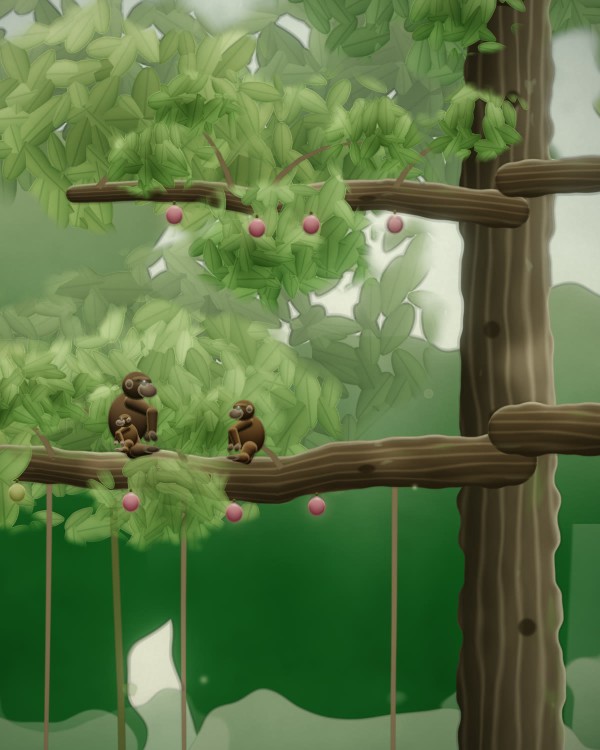
A young ape crossing the treetops with its family: grasp, sway and keep each other safe.
In the game See it on the atlas
Who you are
An ape of the late Miocene, roughly the time and place of Nakalipithecus from Kenya. Its body is built from living great apes, because Nakalipithecus is known only from a jaw and teeth.
What the evidence shows
- Nakalipithecus is about 9.9 to 9.8 million years old and may be close to the last common ancestor of the African great apes and humans.
- Apes and humans share a change in the TBXT gene that may have contributed to the loss of the tail, long before this ape lived. The ape you play has no tail.
- Grass-rich habitats already existed in eastern Africa by about 21 to 16 million years ago, in landscapes ranging from forest to wooded grassland. This ape’s forest was one habitat within a patchwork.
What is reconstructed
- Group life, calls and nest-building are inferences from living great apes, not preserved in fossils.
Sources
What it supports: Nakalipithecus, a great ape about 9.9 to 9.8 million years old known from jaw and teeth, possibly close to the common ancestor of African apes and humans.
What it supports: A genetic change in the TBXT gene, shared by apes and humans, that may have contributed to the loss of the tail.
What it supports: Grass-rich habitats in eastern Africa by about 21 to 16 million years ago, within landscapes that ranged from forest to wooded grassland.
Summaries here are our own. Some publishers limit access to full papers; learning on this site is never paywalled.