
About 518 million years ago
Backbone
A little fish with eyes and the beginnings of a backbone, in a sea suddenly full of hunters.
In the game See it on the atlas
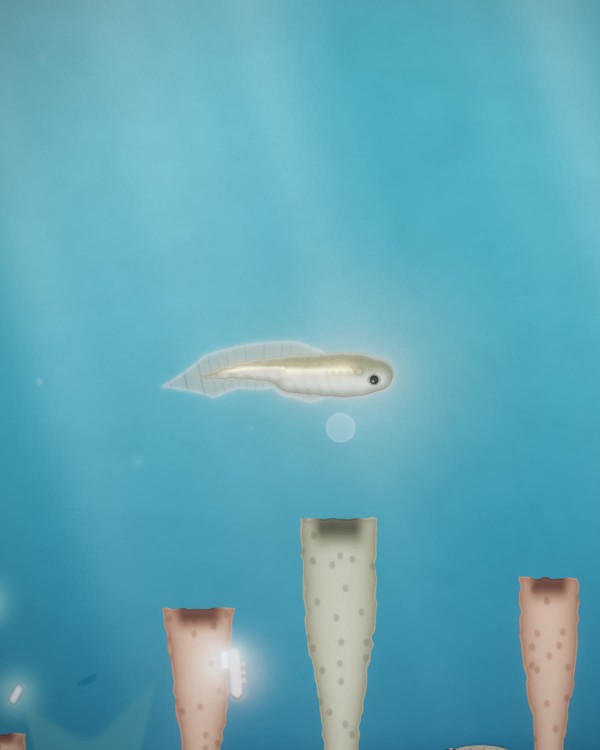
An early vertebrate
Haikouichthys comes from the Chengjiang fossil beds of southern China. It was only a few centimetres long and had no jaws. It stands in for the early-vertebrate body plan our ancestors passed through, not a proven direct ancestor.
What the evidence shows
- Many specimens preserve a head with eyes, possible nasal sacs and what may be ear capsules.
- A notochord with separate vertebral elements is identifiable: an early version of a backbone.
- Analysis places it among the earliest craniates, the group with a distinct head that includes all vertebrates.
What is reconstructed
- Its feeding, escape and social behaviour are not preserved in the fossils.
- Colours and the exact look of its fins are reconstructions.
Sources
What it supports: Haikouichthys anatomy: eyes, possible nasal sacs, and a notochord with separate vertebral elements. Behaviour and ecology are not preserved.
Summaries here are our own. Some publishers limit access to full papers; learning on this site is never paywalled.